
LPDi Retrofit
From Gasoline Direct Injection to LPG Direct Injection.
LPDi (LPG direct injection) injects LPG straight into the cylinder at high pressure. This conversion system turns a gasoline direct injection (GDI) vehicle into an LPDi vehicle.
What the System Offers
The technical basis of the conversion system, in three points.
- 01
Verified Reliability
- Developed over three years by engine, electrification and vehicle development specialists
- Completed as a national project with Korea's Ministry of Environment
- Durability verified over 500,000 km, with performance and fuel efficiency equal to gasoline
- 02
Broad Application
- Applies to vehicles with gasoline direct injection (GDI) engines
- New and used vehicles alike
- Learning algorithm tuned to the fuel: butane and propane
- Developed to meet emission, CO2 and safety regulations
- 03
Simple Conversion
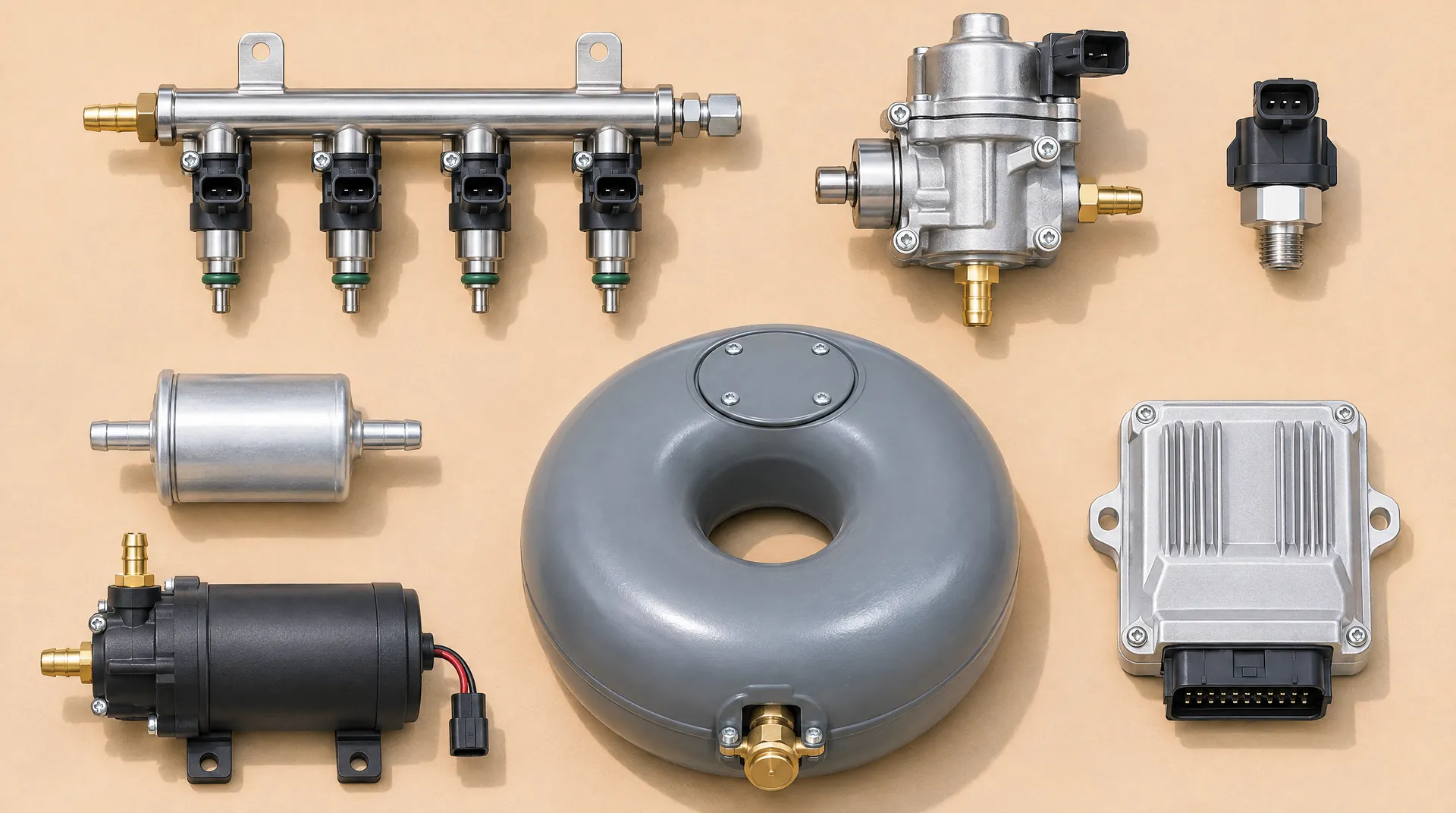
- Seven optimized parts are replaced
- System architecture designed for simple work
- A work process that keeps conversion time short
A System of Seven Parts
LPG leaves the tank, is pressurized in two stages and is injected directly into the cylinder. A dedicated controller, the LHCU, manages the process.
- LPG Tank
- Booster Pump
- LPG Filter
- Sensor Module
- High-Pressure Pump
- Fuel Rail
- Engine
Dedicated Controller
LHCU
Reads the fuel and rail pressure signals, drives the booster pump and low-pressure pump, and passes a fuel quantity correction to the engine ECU.
The seven parts replaced are the fuel rail, high-pressure pump, sensor module, LPG filter, booster pump, LPG tank assembly and the LHCU.
Expected Effects
An LPDi Hybrid Compared With an LPI Vehicle
The figures compare an LPDi hybrid with an LPI vehicle. The basis of each figure is given in the footnote.
- Fuel Economy vs LPI
- +71%*better fuel economy than an LPI vehicle.
- CO2 vs LPI
- −45%*lower CO2 emissions, from 137 g/km to 75.2 g/km.
- Cost Recovery
- within3yrs*to recover the conversion cost through fuel savings.
- Durability Verified
- 500,000km**with performance and fuel efficiency equal to gasoline.
- *Internal analysis comparing an LPDi hybrid with an LPI vehicle. Results vary with the vehicle model and operating conditions.
- **Figures are based on Gooler Mobility's internal R&D results and may vary upon certification and under actual operating conditions.
Engines and Hybrids
The system is developed engine by engine and extends to hybrid vehicles.
Target Engines
Conversion systems for 1.5 L, 2.0 L and 2.5 L GDI engines, developed in sequence.
Hybrid Vehicles
A GDI hybrid can be converted to an LPDi hybrid. Validation testing has been carried out on a mid-size taxi model in the Korean market.
Built to Order
A system optimized for the requested vehicle model can be developed and supplied.
Conversion cost is quoted by vehicle model. Tell us the model and how it operates, and we will review it.
Ask About LPDi Retrofit